
I'm Alex Kearney. I work on Artificial Intelligence and Epistemology.
I'm Alex Kearney. I work on Artificial Intelligence and Epistemology.
Here are collected messy notes from Short's theory of signs. Bits, pieces, and excerpts that I found interesting.
the key insight of these discussions is the need for generality. Generality means thinking in the general sense. Grey is not a single perceptual experience, but rather a collection of classes and instances.
Saussere: linguistic rules determine language and speech; study on the former depends on an a priori study of the latter. This inspired structuralism and actions of people, & thus the actions and history of society depend on an abstract representation which individuals are unaware of.
It was suggested that semiology could be carried over from language to all social behaviour and signs in the broadest sense. This is problematic, as it does not provide a satisfying description of how thought and language manage to be about the world.
Peirce adds an interpretant: the response a sign elicits. A sign, an object, and an interpretant are only taken to be one of three in relation to the other.
I guess an important thing to bring up is that signs---through the process of interpretation---give rise to something beyond the impression.
Each category has to justify itself by induction, giving it a limited and approximate validity (CP 1.301)
Really foreswearing the a priori necessity.
The three flaws of Peirce's semiotic of 1868:
Thought lacks objects not constituted by thinking
A thought-sign being interpreted in a subsequent sign suggests infinite semiosis
If significance depends on interpretants--actual or potential--being signs, then we have no non-circular account of significance.
Peirce fixes infinite semiosis by creating indices.
Icon signification outside of resemblance without thought.
Icons derive their meaning from the feeling evoked by resemblance, thus, non-conceptual creatures can be sign interpreters.
What a sign signifies is from an a priori relation independent fo the sign actually being interpreted. Is then a type of possible interpretant grounded in interpretability.
To make this line of argumentation, two additions are required:
Subjunctive conditional: A form of counter-factual. E.g., "Bob died yesterday. If he had died tomorrow, he would have been 98 years old."
Final Causation: interpretation is purposeful, so interpretation must be relative to a possible action. Interpretability must be real and independent of it actually being actualised: reality of what was, is or could be: potentiality.
Grounding: in metaphysics one thing grounds another, if one thing accounts for the other.
The final problem is infinite semiosis:
1887 pragmatic maxim (w3: 226)
Consider what effects which might conceivably have practical bearings, we conceive of the object of our consideration to have, then our conception of these effects is the whole of our conception of the object.
It is only through purposeful action---even if only a potential action---that worlds and thoughts relate to a world beyond themselves.
More on belief and habit in (w3:247, cf 512)
A stone, a star, or a person is continuous spatio-temporally: undivided though divisible at any number of points... A church, a club, a crowd is never simply the members it has - pg 80
Clearly, when we build systems which perform classification and clustering, we are identifying generalities and continuities in some sense. There are an assortment of examples and kinds which through some form of training are identified. There is some continuity of perceptions which give rise to "cat" , or 'cluster 0'; however, many times they
There is a contradiction between teleology and behviourism and reductive theories. This can be found in mechanistic arguments.
We omit such a clause, as many scientists have thought that subsumption under law suffices to explain the phenomena non-telelogcially.
Fixation of Belief => How to Make Our Ideas Clear
Different minds may set out with the most antagonist views, but, the progress of investigation carries them by a force outside themselves [Peirce's Nominalism] to on and the same conclusion [his realism]... the opinion which is ultimately fated to be agreed upon.
Truth isn't clear when we have more boundaries: china isn't the border, or the people, or the govt... Static sausserean approaches are limited in these fuzzy ways. Behaviour, experience, agent => Peirce.
When we add the interpretant, we add context, interaction, something beyond original sensation.
Concept that it relates to in a meaningful way outside of stimulus.
Only reason that it works in supervised learning is that it is giving.
Back home.
Kansai International Airport → Vancouver International Airport → Edmonton International Airport
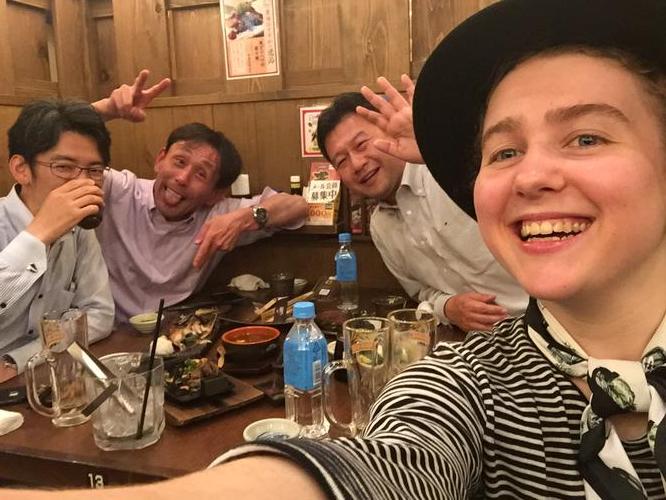
Getting ready to come home.
Kyōto Station → Shinagawa Station → Narita, Chiba
I’m starting my day in a Japanese Cafe and a lot of the radio ads sound like the intro to a future-funk track.
I’m mesmerized.
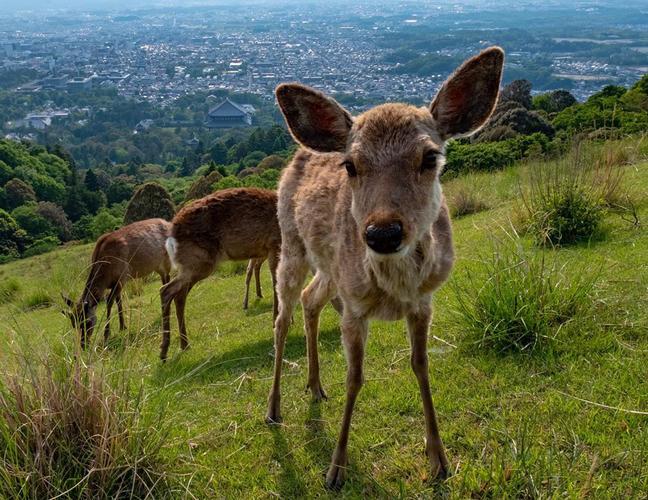
Yesterday I visited Nara and hiked to the top of Mount Wakakusa. The friends I met at the top weren’t just hanging out at the peak: deer are all throughout the city, mingling with people; however, this congregation was a bit more wary of me than the city-dwellers. After sitting and resting a bit they warmed up to me and continues grazing as I watched the sunset over Todai-ji. In Nara, deer are sacred natural monuments believed to be messengers of the gods by one of the local temples.
Kyōto Station → Tōdai-ji → Mount Wakakusa
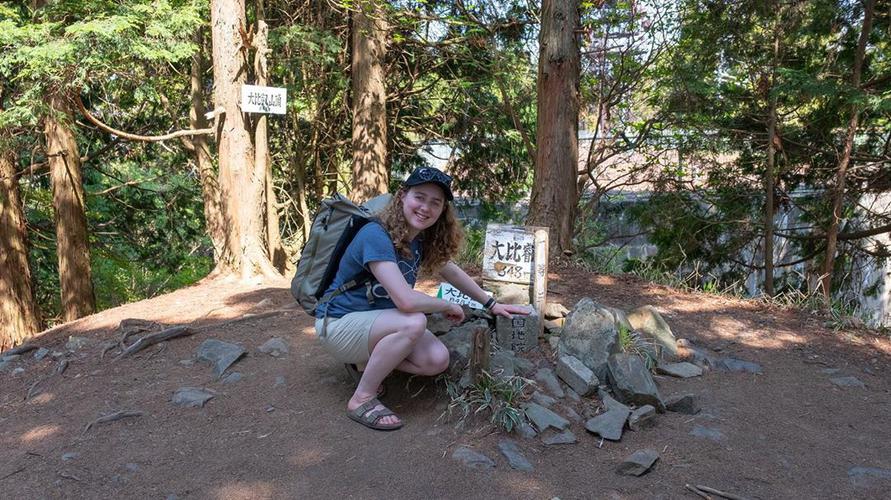
Yesterday I made it to the top of mount Hieie: the second highest mountain in the Kyoto prefecture (according to the family I met at the top). At the top of the mountain I took a break to enjoy some tea and met three groups of people who made it to the top.
The first was a Canadian from Toronto who was traveling.
The second was a trail-runner. He started digging around behind one of the trees and retrieved a mysterious granite pyramid which he placed in front of the tree. He said it was famous. I’m still confused by this.
The third was a Japanese family who hiked the mountain. The father started telling me how young Japanese people don’t like hiking and that Japanese people don’t hike anymore. He told me about all the mountains in the area, the number of mountains in japan, and the heights of their peaks.
I left the mountain informed.
Kyōto Station → Ōtsu → Mount Hiei